
A simple guide to preparing your guest list for printing.
You've chosen your wedding invitations, finalised your guest list, and now it's time to organise your envelopes.
But how exactly should you address them? Do you need to include Mr & Mrs? Should you list every family member? And what about couples who aren't married?
Whether you prefer traditional and formal or something more modern and relaxed, the most important thing is choosing an addressing style that suits your wedding and keeping it consistent.
Here's everything you need to know about addressing your envelopes.
First things first: One invitation, One envelope
Generally speaking, you'll need one invitation per couple or family, rather than one per guest.
For example:
A couple receives one invitation and one envelope.
A family with children receives one invitation and one envelope.
An individual guest receives their own invitation and envelope.
If adult children or other guests living at the same address are being invited separately, you can give them their own invitation.
So, if you're inviting 100 guests, you won't necessarily need 100 invitations. Your final envelope quantity will depend on how those guests are grouped.
The three decisions you need to make
Before preparing your guest list, there are three simple things to decide.
1. First names only, or first and last names?
Both can look beautiful, but how you're delivering your invitations is worth considering.
For invitations being posted, I recommend including your guests' surnames. This aligns more closely with Australia Post's addressing standards and helps clearly identify the recipient.
For example:
John & Sally Jones
Or, if they have different surnames:
John Jones & Sally Smith
For hand-delivered invitations, you have a little more flexibility. First names only can create a lovely, relaxed and personal feel.
For example:
John & Sally
Australia Post's guidelines recommend including the recipient's name, street address, suburb, state and postcode. While their general guidelines don't explicitly prohibit first names only for ordinary letters, including surnames is the safer approach for posted invitations.
2. Traditional titles, or just names?
Would you prefer the traditional approach of using titles such as Mr and Mrs, or would you rather simply use your guests' names?
Traditional
Mr & Mrs Jones
Modern
John & Sally Jones
Neither is right or wrong. Just choose the approach that feels most natural for your wedding.
If you choose traditional titles, make sure they're appropriate for each guest rather than assuming everyone uses Mr or Mrs.
3. How will you address families?
When inviting parents and their children, you can either address the envelope to the family as a whole or list the individual family members.
Family surname
The Jones Family
Individual names
John, Sally, James & Sophie Jones
Both options work beautifully.
Listing everyone by name is a lovely personal touch, particularly for smaller families. Using the family surname keeps things simple and works well for larger households.
Just be mindful that longer names may require adjustments to the envelope layout.
Make it clear exactly who's invited
Your envelope isn't just about getting your invitation to the right address. It also helps communicate exactly who is included in your wedding invitation.
Being thoughtful about how you address each household can help avoid confusion, particularly when it comes to children and additional guests.
For example, let's say you're inviting John and Sally to your wedding, but not their children.
You would address the envelope to: John & Sally Jones Rather than: The Jones Family
On the other hand, if the whole family is invited, you could use: The Jones Family Or: John, Sally, James & Sophie Jones
If you're having an adults-only wedding, addressing your envelopes specifically to the adults is a simple way to reinforce who has been invited.
The same applies to partners and plus-ones. If someone is invited with their partner, include both names. If you're offering an unnamed plus-one, you might choose something like:
Sally Jones & Guest
You can also clarify who is invited on your RSVP card or wedding website.
A good rule of thumb: If someone isn't included in your invitation, avoid envelope wording that might suggest otherwise.
Envelope addressing examples
Here's a handy reference for some of the most common guest combinations.
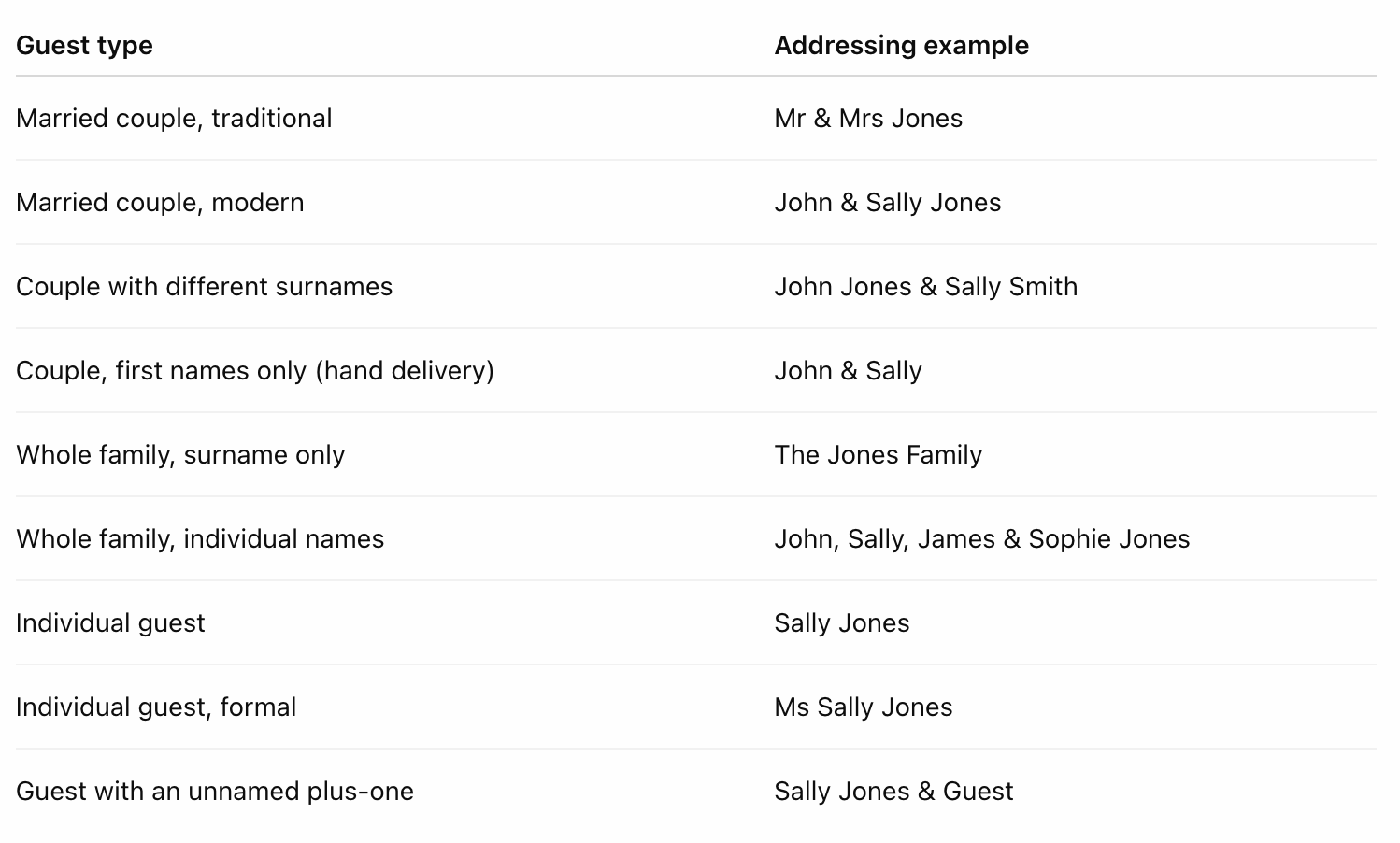
A little note about surnames: Not all married couples share a surname, and not all families do either. If your guests have different surnames, it's perfectly fine to include each person's full name.
The most important thing is to address your guests in a way that accurately reflects their names and preferences.
What if I'm hand-delivering my invitations?
Absolutely fine!
If you're planning to personally deliver some or all of your wedding invitations, you don't need to provide a postal address.
Simply include the names you'd like printed on each envelope, and I'll leave the address off.
You can also mix and match. For example, you might post invitations to guests interstate and hand-deliver invitations to friends and family nearby.
Just make sure it's clear which envelopes need postal addresses and which ones don't.
How should I format postal addresses?
For invitations being posted within Australia, it's important to make sure your addresses are complete and correctly formatted.
Australia Post recommends including the recipient's name, street address, and suburb, state and postcode.
For example:
John & Sally Jones
24 Example Street
Sydney NSW 2000
If your guests live in an apartment or unit, make sure you include those details too.
Australia Post also recommends:
Keeping the address clear and easy to read.
Including the correct suburb, state and postcode.
Placing the suburb, state and postcode together on the final line.
Including a return address on the back or top-left corner of the envelope.
These details are particularly important when your envelopes are being printed in decorative fonts or more elaborate layouts.
For more information, you can refer to the Australia Post addressing guidelines.
A few things to check before sending your list through
Once you've decided on your addressing style, it's time to double-check the details.
Spelling: Check every guest's first and last name, particularly less common names.
Households: Make sure couples and families are grouped together correctly.
Who's invited: Ensure the envelope names accurately reflect who is included, particularly children and partners.
Surnames: Include surnames for invitations being posted.
Titles: If you're using Mr, Mrs, Ms or other titles, double-check they're appropriate.
Postal addresses: Check unit numbers, street addresses, suburbs, states and postcodes.
Hand deliveries: Leave the postal address blank for envelopes being delivered in person.
Consistency: Check that your chosen naming style is applied throughout the list.
Remember, your guest names and addresses will be printed using the details you provide, so it's worth taking a little extra time to check everything carefully.
Ready to send through your guest list?
Once you've made your three addressing decisions, putting your list together should be fairly straightforward. You can download our Belle Measure addressing template here (this is the exact format I require from my clients).
You don't need to worry about making everything overly formal or following outdated etiquette rules. Just choose a format that suits your wedding, make sure it's clear who is invited, check your details and keep things consistent.
And if you're ever unsure how to address a particular guest or family, you're always welcome to ask.
After all, your envelopes are the very first glimpse your guests will have of your wedding stationery. Let's make them lovely.
